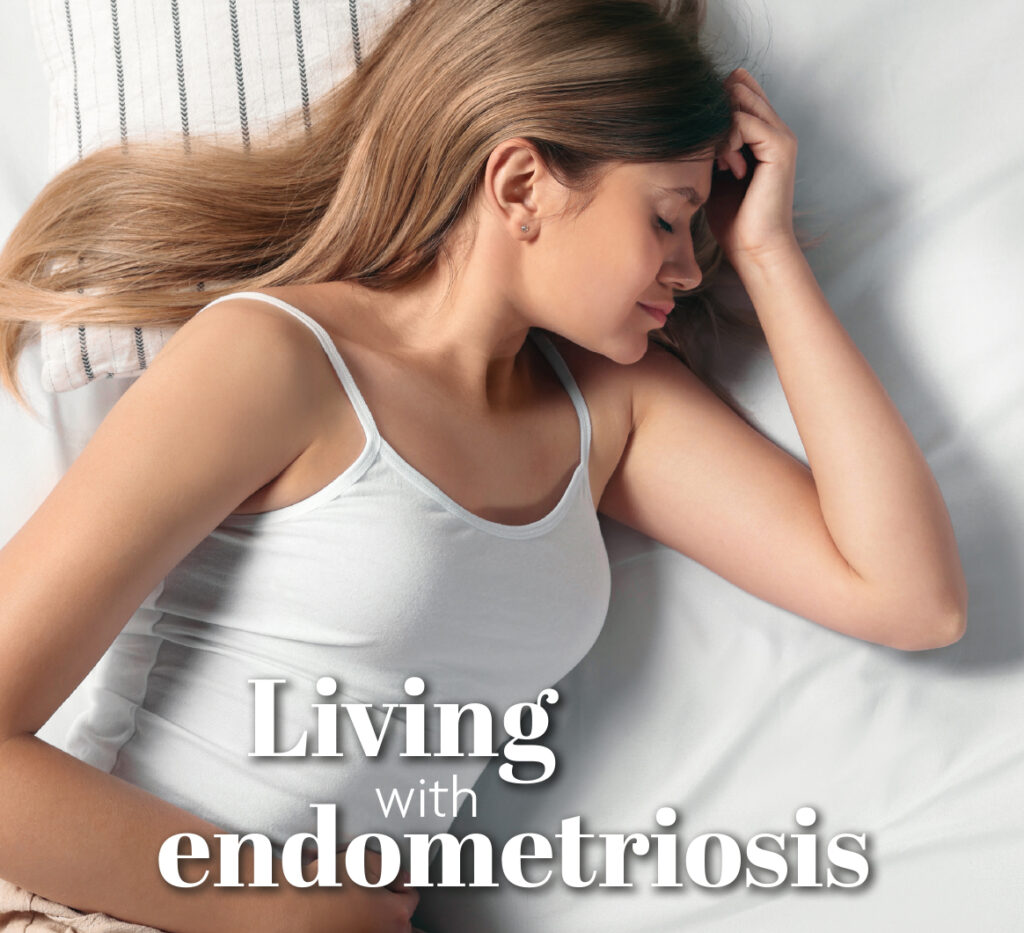
From crippling periods to pain when going to the toilet, over 1.5 million women across the UK are living with endometriosis. The chronic condition can be difficult to diagnose; we spoke with GP and co-founder of AberGP, Julie Gray, to find out more about the condition.
What is endometriosis?
Endometriosis can impact both your mental and physical health. It occurs when cells similar to those found in the lining of the uterus, grow in other parts of the body. It is often found around the ovaries, fallopian tubes and lining of the pelvis. It can also affect your bladder and bowel, and can even be found in the chest. Doctor Gray explained why it can be so difficult to diagnose. “Symptoms vary considerably between individuals in their nature, location, severity and pattern, and they can change over time,” she said. “Symptoms can also overlap with those of many other, much more common conditions, as well as conditions that need to be excluded more urgently. There isn’t currently a single straightforward test that can reliably diagnose or exclude endometriosis. Some forms of endometriosis can be seen on ultrasound or MRI, but a normal scan does not rule it out. Pain and other symptoms are experienced and described differently by different people. Taken together, this can make endometriosis a challenging diagnosis, even when symptoms have been present for some time.”
Symptoms
Endometriosis makes itself known because patches of it break down, but are unable to bleed. This means it can’t leave the body. Symptoms often arise during your period, making period pain severe. You could be faced with incredibly heavy periods, with pain in your lower tummy and back. You can also experience pain going to the toilet, and be faced with extreme tiredness.
Advocating
It is important to speak up about your symptoms, even if a diagnosis isn’t forthcoming. “If an initial assessment doesn’t identify a clear cause, that doesn’t mean there isn’t one, and it certainly shouldn’t mean that you have to simply live with your symptoms,” said Doctor Gray. “If you are wondering whether your symptoms could be due to endometriosis, it is entirely reasonable to ask, “Could this be endometriosis?” You can also ask what conditions have been considered or excluded, and what the next steps might be if your symptoms continue. If things aren’t improving, it is important to seek further review and let your healthcare team know that the problem is ongoing.”
Treatment
There is no one treatment fits all for endometriosis. “Surgery can be an important and effective treatment for some women, particularly when symptoms are severe, significantly affecting quality of life, or when other treatments have not provided adequate relief,” said Doctor Gray. “However, surgery is not necessary or appropriate for everyone, and the extent of endometriosis does not always correlate with the severity of someone’s symptoms. Many women can achieve good symptom control with non-surgical treatments, such as pain relief and hormonal treatments, where these are appropriate and acceptable to them. These approaches are generally less invasive and can be very effective.”
For a consultation with Doctor Gray or to find out more about AberGP, go to abergp.co.uk