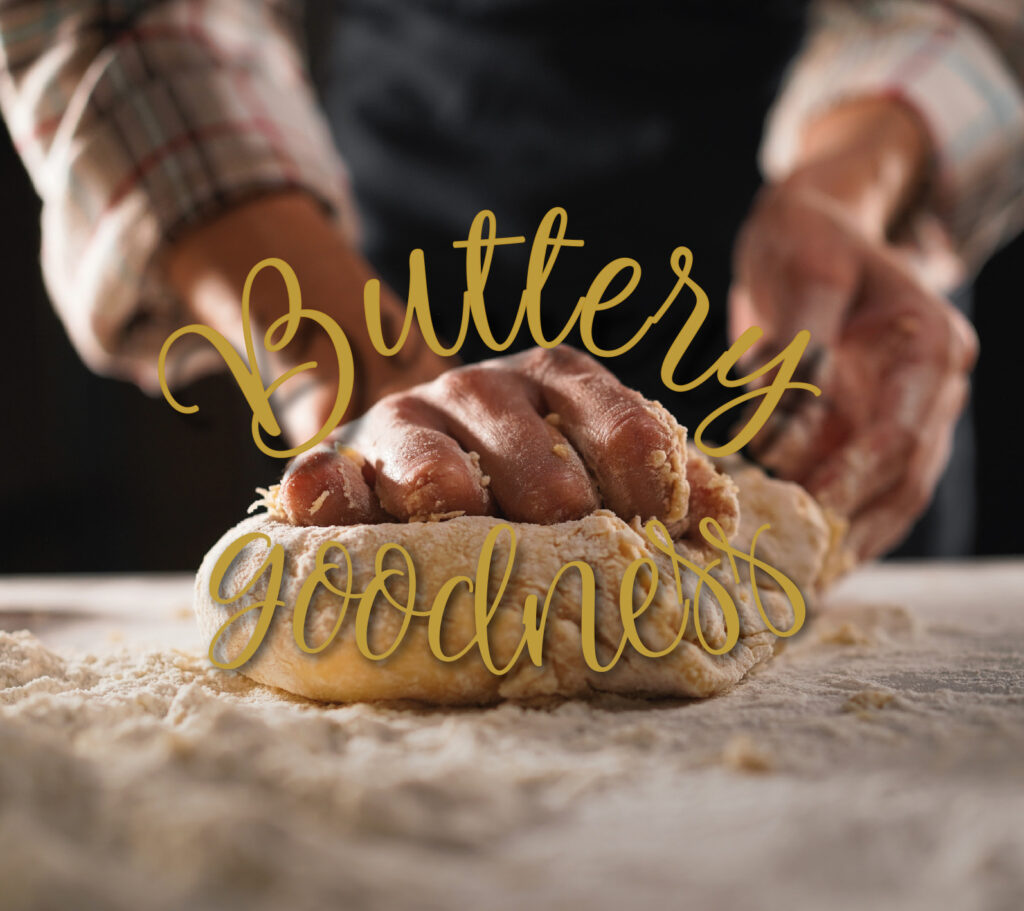
If there’s one food that epitomises NE Scotland, it’s the buttery, that salty, savoury, flaky, crispy roll that combines hundreds of years of history and a surprising amount of lard…
Traditionally, a lot of work goes into making a buttery. The ingredients, strong bread flour, caster sugar, yeast, butter, water and lard. Some older recipes called for the addition of meat stock and most modern recipes swap out lard for other fats such as palm oil. The water, flour, sugar and salt are formed into a dough and left to prove for at least an hour. The cold butter and lard is chopped into tiny pieces. The dough is rolled and the butter and lard sprinkled over before the dough is folded and rolled again. The fat is added in several stages, with the rolling process taking place each time. Eventually, the dough consists of many layers, with the butter and lard spread throughout the dough. A long proving time and cold fat provides the best results.
If a croissant is light and airy, then a rowie is something more robust and rough-edged. Butteries can be thought of as the Jason Statham of baked goods.
They were originally created for the men on fishing boats as the high salt and fat content meant they would last longer than normal bread. Back in the First World War, they were banned when the Ministry of Food decreed that no bread products could be sold until they had been out of the oven for 12 hours. The idea was to control consumption, even though bread was a staple of most people’s diets, and particularly for the less well off. It was still permissible to sell butteries after they had sat around. Aberdeen’s bakers responded by arguing that the high fat content meant butteries were not really a type of bread and needed to be exempt from the restrictions. After several such representations to the Food Controller, it was eventually decided that no bread could be sold that contained margarine or fat and several local bakers appeared in court and were fined a pound for selling four fresh rowies costing half a penny each.
Not everyone proved a fan, with Sir Terry Wogan describing his first taste of a buttery as being like, ‘a mouthful of seaweed,’ and ‘disgusting.’
Sir Terry’s opinions aside, they are best eaten gently warmed under the grill then slathered with butter. Many people opt for jam or golden syrup as well and there have been a number of innovations like pizza butteries and cheese and bacon varieties. Marmalade or peanut butter are just about acceptable, but there’s something far wrong with anyone who puts Nutella on a buttery.
The Buttery World Championship was held in 2024 after a six year hiatus. The professional competition was won by Mark Barnett, who retained his title, with Iryna Porfilova of Bakes You Knead in Forres running a close second and Shona Jamieson of The Highlander’s Bakehouse near Ballater placing third.
The big debate, naturally, is all about who makes the best one. It’s one thing everyone has a firmly-held opinion on. Some people would rather switch football teams than change where their buttery loyalties lie. Many people recollect Aitken’s butteries with something approaching worship and claim there’s been nothing to match their recipe since Aitken’s closed up shop in 2018. Truffelos generally rate highly, perhaps because they are said to be made by someone who previously made them for Aitken’s, The Bread Guy is also said to have access to the Aitken’s recipe. Murdoch Allen’s are well regarded, particularly if you favour something towards the crunchier end of the rowie spectrum, but Vegan Bay consistently top local opinion polls, despite the complete absence of both butter and lard.