As a jewellery designer, you might think Jacqui Grant’s working life provides more than enough of a creative outlet, but here she explains the how she unwinds with her knitting needles…
‘I was born and raised in Shetland, where we were taught to knit in primary school, but it’s also passed down from generation to generation. It’s more than a pastime or a fashion statement, it was how people passed the long nights and was a major contributor to household income. My dad knitted jumpers on the knitting machine and mum knitted in the jumper yokes and grafted the garments together in the evenings when she had a young family and couldn’t be out at work.
‘Fair Isle lies between the Orkneys and the Shetland Isles. The population is around 60 people and the Island is just three miles long and half as wide. In Aberdonian terms, that’s around the same size as Cults, Bieldside, Milltimber and Peterculter and down to the river, so it’s pretty isolated. Other than knitting, there are few tourists and most of those come to watch birds.
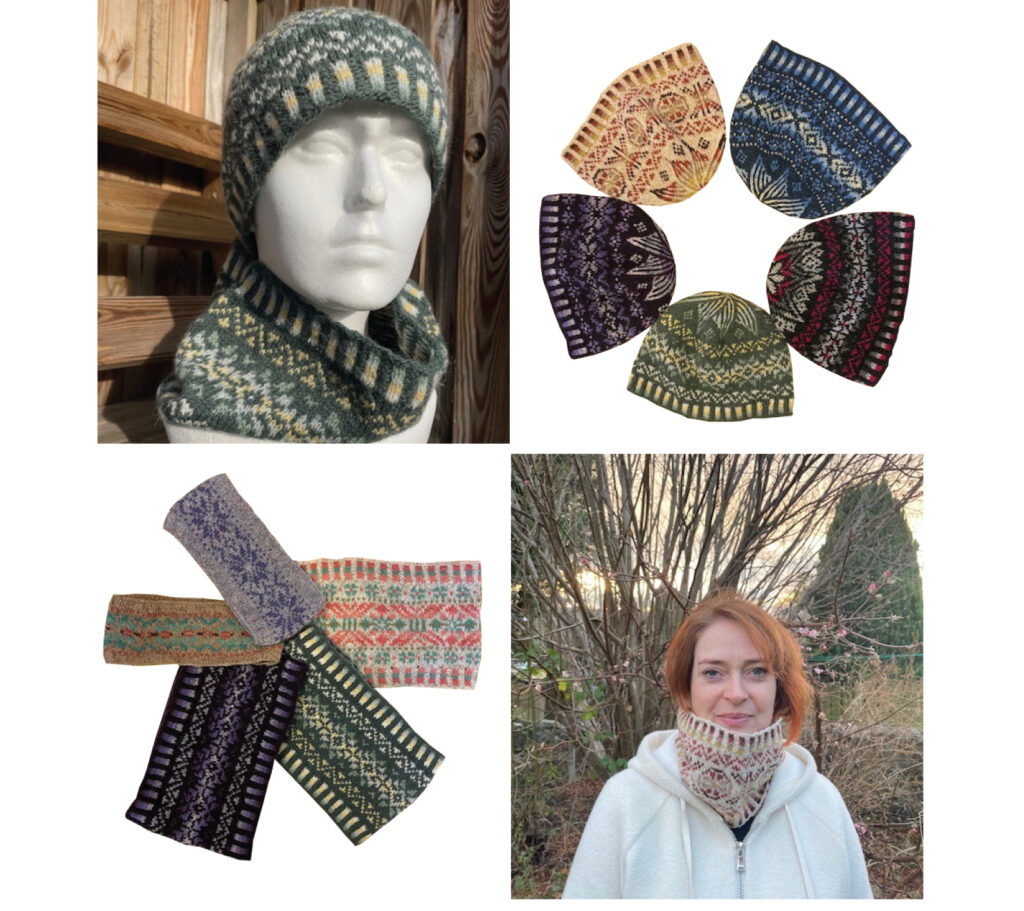
‘Fair Isle knitting is all about pattern and colour, characterised by bands of geometric motifs repeated round a hat or the yoke of a jumper. It’s often emulated and you can find inauthentic versions made in China or machine knitted in acrylic. Real Fair Isle means a limit of two colours a row and a harmonisation graduation of colours that create a pleasing effect. Often patterns are shared in families and in specific areas of Shetland.
‘I find it soothing because you lose yourself in counting. It’s a bit like swimming lengths and there’s something quite Zen about it. You need a good memory and the ability to focus too.
‘People sometimes wonder why Fair Isle knitting is so expensive, but that’s a combination of the cost of the materials and the sheer amount of time needed to create a garment. A Fair Isle hat can take ten hours and lace items require even more concentration and time to produce.
‘Shetland Knitting encompasses a number of different styles. There are gossamer cobwebs of Shetland lace, most commonly made into shawls. Traditionally, the shawl had to be fine enough to be pulled through a wedding ring and the work is incredibly intricate and skilful. These pieces I make for special occasions, generally for family members, usually for the birth of a baby.
‘Each year there’s a Shetland Wool Week which showcases the craft and promotes the heritage and skills involved. Visitors travel from Canada, America and all over the globe to take workshops and classes in different styles of knitting, colour work and lace workshops.
‘Back in September, I showcased my fair isle knits at NEOS as part of a fundraising effort for the Brain Tumour Charity after a relative passed away. I completely sold out of all my stock. Not only did this raise over £2000 for the charity, but I was really surprised by how many people were interested in the techniques and pieces I produced. So many knitters brought in their own pieces for advice or were interested in trying it for themselves.
‘This year I’m considering doing NEOS again and I’d love to run some workshops in conjunction with local wool shops and perhaps sell some pieces via craft fairs or shops.’
You can see more of Jacqui’s work on Instagram @JacquiShetlandKnitter and email her on ginger171@hotmail.co.uk